Tuesday, May 19, 2015

Strumming 103 - Simple Tweaks

In this month’s post I close out the topic of strumming by discussing several issues which can arise with beginning players: heavy-handedness, using “too much” pick, stiff pick syndrome and “angled” strumming. Normally these problems require small “tweaks” to a players’ technique and with regular attention by both student and teacher they can be resolved. 

Quite frequently the issues of heavy-handedness and using too-much pick are intertwined. Heavy-handedness is when a student is trying to use too much force to strum across the strings and this can be the result of using “too much” pick. Whereas, the student is using a large portion of the pick to strum as they are trying to “insert” the pick between the strings when strumming rather than allowing it roll across the top of the strings. 
Strumming with too much pick and inserting it between strings

Moreover, new players may be showing signs of stiff pick syndrome (yes, I know) – meaning they are gripping the pick so tightly they are not allowing it to flex as it moves across the strings; lightening up the grip will go a long way in creating a relaxed and smooth strum. 

Finally, it is quite common for players starting out to strum on a wide angle rather than simply up and down. Generally this occurs 
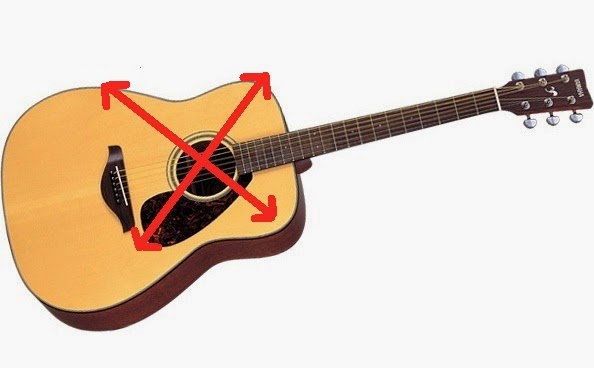
Using too much elbow can cause a wide strumming angle

when a player is relying too much on their elbow for strumming. Using a “equal amount” of both elbow and wrist will help to
Controlled strum
achieve a more controlled strum and produce a more even tone.

Wednesday, April 22, 2015

Strumming 102 – Mechanics of Movement


Last month I began the topic of strumming by reviewing the position the arm uses when playing. This month I’ll focus on the mechanics or how the body moves when players strum or pick. 


If you watch players of various of styles inevitably it seems that there is no “one way” strum the guitar. However, the truth is all players move from two spots in order to play – the wrist and elbow. How much a player moves from these areas really depends of what they are playing. 

For example, funk players generally use wider wrist movements and less elbow, while acoustic players may combine larger movements of the wrist and elbow and jazz guitarists tend to use less wrist when strumming and move more from the elbow - this is especially true when playing four to the bar style ala Freddie Green. 

No matter the style or level one is playing at some basics principles must be adhered to: (1) Keep a loose and relaxed wrist. (2) The wrist should be straight or have as little bend as possible. Why? Think of a water hose – when it is straight the water flows freely through the hose, but when bent (especially at extreme angles) the water does not flow as smoothly. A straight wrist will not only help reduce tension when playing, but also lessen chances of injury. A straight wrist (or one with little bend) is a good rule of thumb for both picking and fretting hands.


Straight Wrist w/ slight bend
Bent Wrist - too much bend 

Don’t be bashful about checking a student’s wrist or mentioning to them numerous times that they need to move from the wrist and keep it relaxed when playing. Moreover, have them hold your wrist as you strum so they have a tactile example of what their wrist should feel like.

Tuesday, March 31, 2015

Strumming 101 – Basic Positioning

The last several posts have covered chord basics, but this month I’ll begin to tackle the “how's” of strumming and talk about the basic playing position. It may be a good idea to review how to hold the pick with students before getting started.


Generally speaking, there is one position in which the arm positions itself in order to strum and that is with the middle of your forearm rested over the edge of the guitars’ lower bout. Exactly where the forearm rests depends on the player and where one intends to strum. 


For example, if a player wants to strum towards the neck they may rest the forearm more towards the elbow or rest closer to the wrist in order to play closer to the bridge. Moreover, slight adjustments to the position will be made from the elbow and shoulder. 

Next month I’ll delve into the actual mechanics and how the arm should move to create a relaxed and smooth strum.